Creating Zones of Stability

Constant change and innovation makes us sick. We need to create Zones of stability and reliability.
The key take away is simple: we need both. We need stability in agility and agility in stability. But the unquestioned bias towards change, innovation and transformation has lead to an imbalance of stable and flexible elements. This leads to constant stress, burn-out and a decrease in effectiveness. Sustainable Transformation needs Zones of stability to unfold its benefits for human prosperity. We are asked to get ahead of innovation and transformation so it serves us, rather becoming addicted and condemned slaves to a heated circle of unnecessary and detrimental changes.
It takes some courage to not to change
I am one of those postponing the next software update on my smartphone as long as possible. I know exactly what will happen: things will not be better but different. But most of the time the changes are for nothing: this time for example Apple thought it was a great idea to shift the google search field from the top to the bottom of the screen. It feels to me like being sent in circles that don’t leave you in a better place but basically force you to move in a closed room. In German there is a word called “Verschlimmbesserung”: Improvements that make the situation/product/service actually worse. BIC pens is one of the great examples of a stable product that is perfect. The very reason for its decade long success was the courage to not to change it:
Constant change is a root cause of burnout
“Normally it is not problem for a human beings to adapt to new conditions” says Hartmut Rosa, one of the leading and most distinctive voices in contemporary social theory. “But only if they can count on a longer time of stability. Nevertheless, today you can sense a downright urge of many bosses for constant reorganization to achieve more efficiency. Employees are aware of the fact, that the next reform will follow shortly, so they have no time to adapt to the current new situation. This attitude cultivates cynicism within people towards work, the world and life in general. The next step is a Burnout. People also miss out on experiences of resonance, a feeling of being in relationship with the world around”
We are stuck in an unquestioned circle of constant innovation, acceleration and superation.
We have come to believe that constant innovation and change is a natural condition of life. In some way it is, life is change, and everything is moving together. But if we look closer we could discern between a “natural change” that is happening in a human pace, giving us time to adapt and realign.
And then we have something I call “enforced change” that is not rooted an intrinsic necessity of life but in an unquestioned collective narrative. This narrative arose within the “Moderne” or the 18th century and can be summarized in one sentence: A society can only sustain if it changes, accelerates, grows and innovates. Growth became a structural necessity and this was a new idea. The important point for me is, that this is and idea, an invention, something we chose to belief and live up to it until today.
We are forced to outperform the past. Every year.
All of this wouldn’t be a problem either, if it was not a root cause of our collective suffering from lack of time, quality of life and inner peace. Externalized it leads to an acceleration of exploitation of natural, emotional and also spiritual resources. Being forced to grow means being condemned to never arrive anywhere. Every year we start at zero turnover and are forced to outperform our own last year’s performance. The speed of computers, the amount of data created doubles every 2 years, according to Moor’s law. We are in a self-enforcing cycle: the faster we innovate, the more changes, the faster we need to adap
We have created a Sisyphus-like environment for ourselves. We have condemned ourselves to innovation and exploitation. When the original idea of the Modern was to make life easier, more comfortable and expansive for us, we now have no way to make the world and our lives a better place. The best we can hope for is not to fall behind expectation and competition, for the stone not to role over us.
A young woman summarized her expectations towards politics in this way: “Not to make the world even worse. To stop destruction”. Hartmut Rosa says the impossibility of arriving and reaching a certain positive state in the future is one of the reasons for the increasing cases of anxiety, depression and suicidal thoughts, especially among the younger generations.
Add We cannot resist and stop change, transformation and adaptation. But we can create islands of relative stability, stillness and continuity
One question I start to ask my clients is the following: “What do you want to NOT change?” What are zones of stability and continuity? I am not surprised that the trend of agility, promoting constant change, was followed by the “Purpose” trend. The search for purpose and meaning stands also for the desire of something that is “eternal”, stable, deep, reliable.
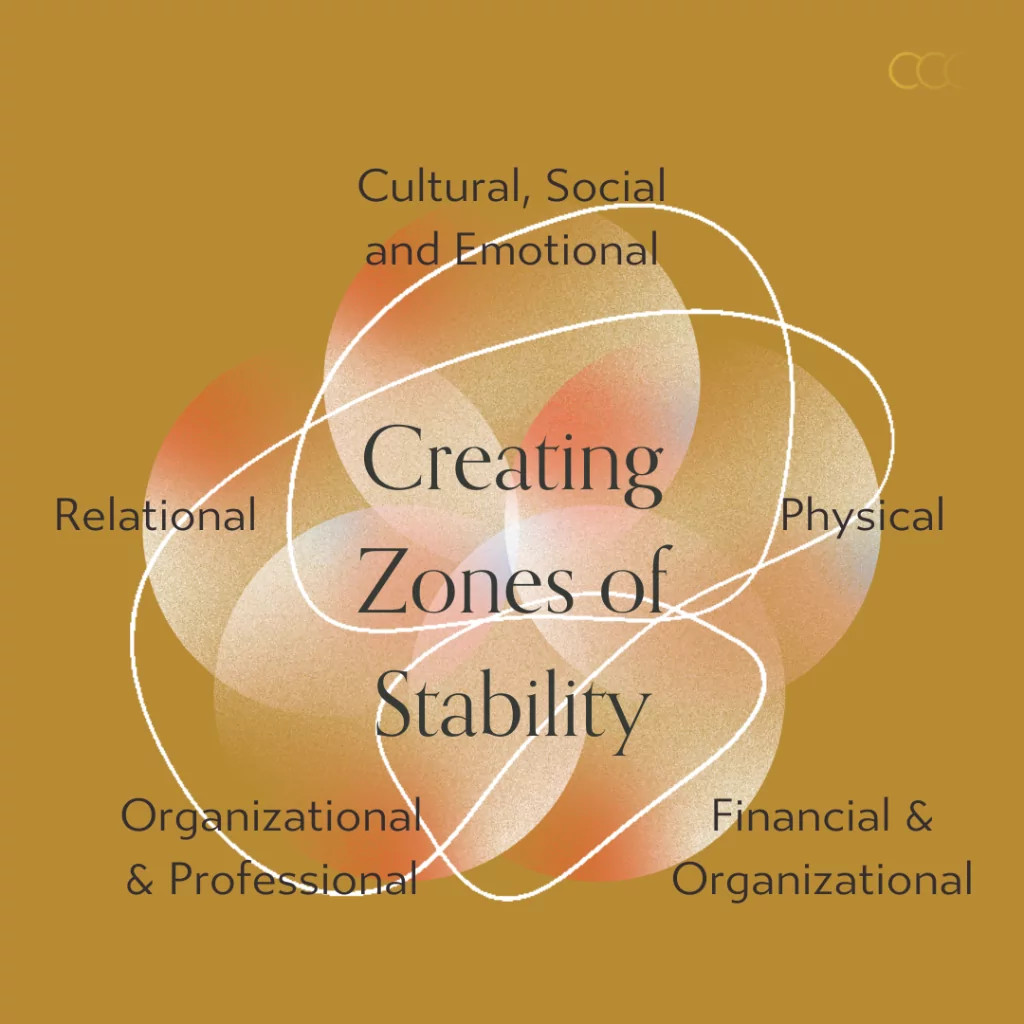
We have different types of stable zones we can establish. I would like to point out just a few:

Physical stability: A home, a place we can come back to, that is always there. Physical stable places are very important for us, we are territorial beings. The idea of desk sharing and flexible offices created lots of stress in people, and many organizations dropped it. In a world that is changing every day, a stable physical place can give us a sense of belonging a safety.
Relational stability: “Time to move” – this principle of France Telecom meant for Leaders that they had to change position after a maximum of 36 months. The fear was that strong personal relationships with employees could lead to a loss of efficiency. Leaders should not feel “at home” with their team but rather stay flexible. As a result France Telecom was confronted with high Burnout rates, depressions and a wave of suicides: 40 in 2 years. This example shows the huge amount of stress we put on people when forcing them to move and change and leave personal relationships. We are not only territorial but also interrelational beings.
Basic Financial stability: I was surprised to learn, that my young co-worker complained about the lack of financial stability I could grant her. I could commit to only a couple of months of stable income, depending on the external situation. Being in a situation of an unstable income myself I couldn’t grant it to others either. I saw how much stress this created in her and also in me then. I don’t have a solution right now, but at least aiming to give people a minimum sense of financial stability can release the level of collective stress we cause for each other.
Professional stability: Yes, of course, there is this paradigm of lifelong learning. We have little appreciation for professional mastery – people who have been practicing their profession for decades with a deep mastery in what they are doing. For many people it causes a lot of stress to feel they have to start from Zero every 3 years. Not everyone loves to reinvent him- or herself and the “change or die” paradigm creates fear and a resistance to change altogether. We should not force people to have to start a new professional career without necessity, just to keep them “agile”.
Cultural, Social and Emotional stability: Organizations need to adapt, no questions. If we look at the level of parallel innovations and developments, we cannot stop it. But what we CAN do is to create a sense of relative cultural stability. There is something we together can rely on. Be it a level of mutual support, trust or communication style, we can create a space of emotional stability through shared values and principles. Rituals play an overly important role in Social stability: nothing is worse than taking away the traditional Christmas or Summer Party away. Regular time-outs as Leadership Team. Morning coffee with my colleagues. We need this sense of reliability: something will be still here tomorrow.

Structural stability: By this I mean to create structures that are so simple, robust and flexible at the same time, that they don’t need to be fully changed and shifted with every wave of novelty. Instead of stumbling from reorganization to reorganization with the idea of creating the perfect solution for the current moment I would suggest, to create layers in organization. A basic and simple hierarchy that gives everyone an organizational home and one person to turn to for basics like salary increase, assignment and development, a flexible layer consisting of projects, networks, self-organized initiatives and an informal layer of relationships, support systems and mentoring.
We could add a “relative” to all Zones of stability, because, as we know, nothing is ever fixed forever. But in a way we can influence our own attitude and behavior and create stable zones for ourselves and others.
